
Skip to content

Room 04 · 1885–present

Faith and Community

Places to gather, things to carry forward

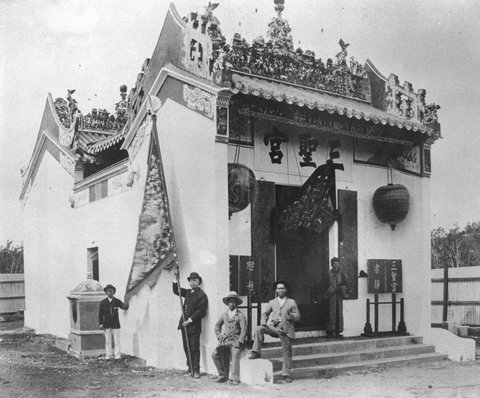
Holy Triad Temple, Breakfast Creek, 1886. The entrance and decorated roof frame the people gathered outside.

State Library of Queensland, negative 10124, 1886. Photographer unidentified. Open the source (opens in a new tab)

Room 04

Faith and Community

A community needs more than a place to work. It needs rooms for worship, company, music and the keeping of memory. Explore temples in Brisbane, Atherton and Croydon, then pause with three gardeners holding musical instruments in Irvinebank. Buildings, inscriptions and photographs preserve different traces of belonging. No single temple or image can stand for every Chinese Queenslander’s beliefs or experience.

Room 04 · 01

1885–1886

A temple beside Breakfast Creek

The Holy Triad Temple grew from the needs of Brisbane’s Cantonese community. Built in 1885–1886, it brought worship and community gathering into a shared place near the market gardens of Breakfast Creek.

Donations supported construction, while decorative work and fittings connected the building to China. The 1886 photograph records the temple and people outside it; it cannot tell us everything that happened within. Look at the building as both a religious place and a meeting point in a working community. The museum’s longer temple article follows its history in greater depth. Today the temple remains a place of worship, so its history should be approached with the respect owed to a living sacred space.

Holy Triad Temple, Breakfast Creek, 1886. The entrance and decorated roof frame the people gathered outside.

State Library of Queensland, negative 10124, 1886. Photographer unidentified. Open the source (opens in a new tab)

Continue in the museum

Room 04 · 02

1903

Local timber, connections across the sea

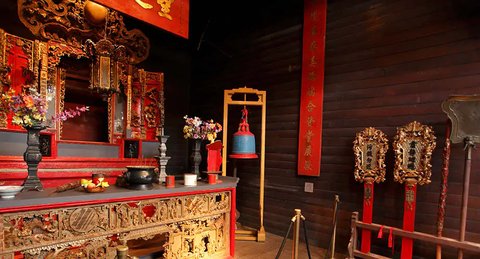
At Atherton, community members raised money to build Hou Wang Temple in 1903. Timber and corrugated iron suited its Queensland setting, while furnishings made in China carried another world into the building.

The National Trust describes carvings, a bell, metal vessels and inscriptions recording contributors. Such objects invite close attention: a name on an inscription makes collective effort visible. The temple served people living across the district, offering a social as well as spiritual focus. Its survival also reflects later care and conservation. What remains today is not an untouched moment from 1903, but a place whose history includes use, decline, repair and interpretation.

Hou Wang Temple and Museum in a contemporary National Trust photograph. The image shows a conserved place, not its appearance on opening day.

Image source: National Trust of Australia (Queensland), Hou Wang Chinese Temple and Museum. Open the source (opens in a new tab)

Sources for this story

Room 04 · 03

Place story

A community read through its remains

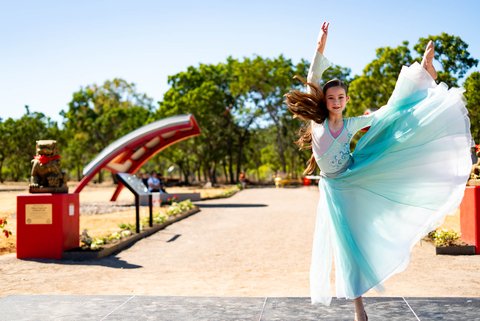
At Croydon, the Chinese Temple and Settlement Site preserves a community through what remains in the ground. Temple foundations, house footings, an oven and scattered material connect worship with cooking, shelter and everyday work.

The council’s heritage trail brings these traces into conversation with inscriptions and historical research. Its renewed visitor interpretation opened in 2025. Conservation and modern additions should be distinguished from original remains: a present-day entrance is not evidence of how the old settlement looked. Walk the site through its records, leaving objects in place. A fragment matters not only for what it is, but for where it was found and what stood around it.

The Chinese Temple and Settlement Site as presented by Croydon Shire Council today. Contemporary interpretation helps visitors read the surviving place.

Image source: Croydon Shire Council, Chinese Temple Site. Open the source (opens in a new tab)

Sources for this story

Room 04 · 04

10 July 1908

Music beside the working day

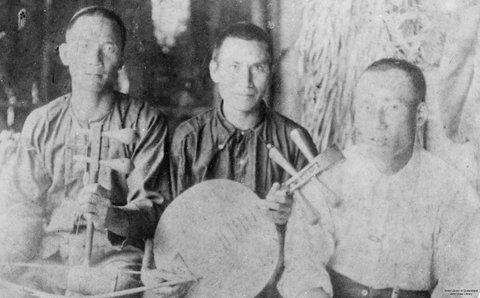
Three Chinese gardeners from Irvinebank sit for George Milne’s camera with musical instruments in their hands. The State Library dates the portrait to 10 July 1908 and identifies an erhu at the left and a yueqin in the centre.

Their working lives need not be the only lens through which we see them. Instruments bring another part of community experience into view: skill, recreation and the possibility of shared music. Yet a posed photograph cannot tell us what was played, how it sounded or what each person felt. Stay with what the image preserves, while leaving room for the lives that continued beyond its frame.

Three Chinese gardeners from Irvinebank with instruments, 10 July 1908. Photograph by George Milne, State Library of Queensland, negative 96416.

George Milne, 10 July 1908. State Library of Queensland, negative 96416. Open the source (opens in a new tab)

Room 04

Timeline

Open a dated entry, then follow it to the story.

  1. 1885–1886A temple beside Breakfast Creek

    The Holy Triad Temple grew from the needs of Brisbane’s Cantonese community. Built in 1885–1886, it brought worship and community gathering into a shared place near the market gardens of Breakfast Creek.

    Read the story: 01 · A temple beside Breakfast Creek
  2. 1903Local timber, connections across the sea

    At Atherton, community members raised money to build Hou Wang Temple in 1903. Timber and corrugated iron suited its Queensland setting, while furnishings made in China carried another world into the building.

    Read the story: 02 · Local timber, connections across the sea
  3. 10 July 1908Music beside the working day

    Three Chinese gardeners from Irvinebank sit for George Milne’s camera with musical instruments in their hands. The State Library dates the portrait to 10 July 1908 and identifies an erhu at the left and a yueqin in the centre.

    Read the story: 04 · Music beside the working day

Room 04

Map

Choose a place to find its stories. The list offers the same links as the map.

Schematic map of Queensland. Places are approximate; markers are for orientation, not travel directions.

Map

Choose a place to find its stories. The list offers the same links as the map.

Stories

  1. 1.Brisbane

  2. 2.Atherton

  3. 3.Croydon

  4. 4.Irvinebank

Room 04

Objects and records

Look closely at the records and images used in this room. Original items are held by the credited institutions or remain at their sites; they are not owned by this museum.

Room 04

Sources and image credits

Images are credited beside each figure. Follow the source links to explore their original context.

  1. Navigate through Newstead: Holy Triad Temple (opens in a new tab) — Brisbane City Council
  2. Holy Triad Temple, Breakfast Creek, 1886 (opens in a new tab) — State Library of Queensland
  3. Hou Wang Chinese Temple and Museum (opens in a new tab) — National Trust of Australia (Queensland)
  4. Hou Wang Miau, Queensland Heritage Register 600010 (opens in a new tab) — Queensland Government
  5. Chinese Temple Site (opens in a new tab) — Croydon Shire Council
  6. Portrait of three Chinese gardeners from Irvinebank, Queensland, 10 July 1908 (opens in a new tab) — State Library of Queensland